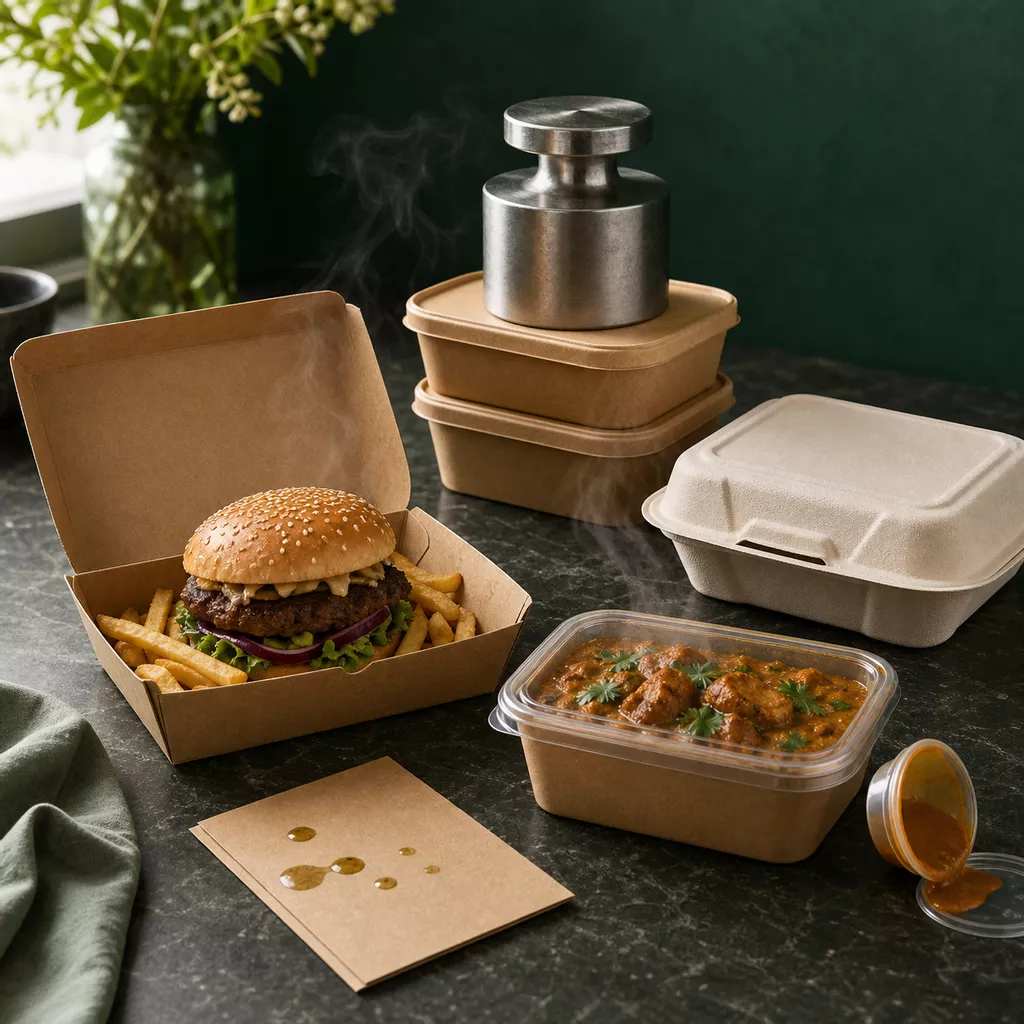


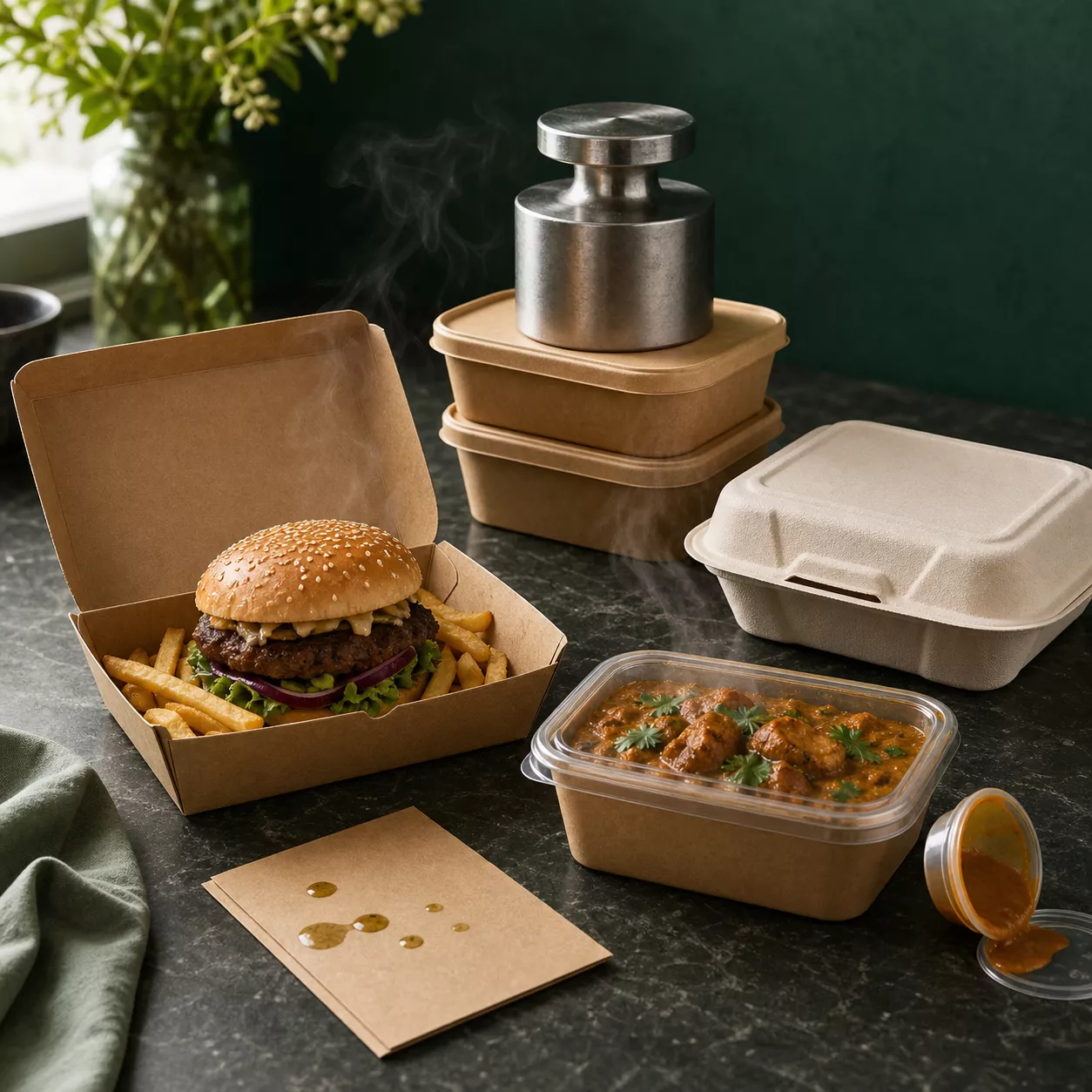
What makes food packaging strong?
Food packaging strength is the result of several factors working together, not one impressive-looking number.
- The type and quality of material
- The amount of material used, sometimes shown as GSM
- The pack's shape, folds, seams and rim design
- Any coating or barrier applied
- The fit between the container and its lid
- The weight, heat, moisture and fat content of the food
- How the filled pack is stacked, handled and transported
GSM matters, but it is only one part of the answer. A well-engineered lower-GSM container may perform better than a heavier board with weak folds, a poor coating or an unsuitable lid.
What does GSM mean in food packaging?
GSM stands for grams per square metre. It is the grammage, or mass per unit area, of paper or board. A square metre of 300 GSM board weighs 300 grams.
The formal method for determining paper and board grammage is set out in ISO 536. In everyday buying, GSM gives you a useful indication of how much paper or board is present. It does not directly measure thickness, stiffness, compression strength or leak resistance.
Does a higher GSM mean stronger packaging?
Often, but not always. If two packs use the same material, construction and coating, the higher-GSM version will usually feel more substantial and may resist bending better. In the real world, packs are rarely identical in every other respect.
Strength also depends on fibre composition, thickness, density, shape, moisture exposure, barrier coating and closure design. Corrugated packs gain much of their strength from their layered structure. Ribs, folded corners and curved walls can add rigidity without simply adding more material.
Think of GSM as one clue, not a quality score. If a supplier promotes a high GSM without explaining the material, construction or intended use, the specification is incomplete.
Leak-proof vs leak-resistant: what is the difference?
The terms sound similar, but they set different expectations.
Leak-resistant
Designed to reduce the escape of liquid during normal handling. It may cope with moist foods, dressings or short journeys while upright, but should not be assumed to contain free-flowing liquid in every position.
Leak-proof
Presented as providing a higher level of containment when correctly closed and used within stated conditions. The food, fill temperature, holding time, lid fit and test method still matter.
There is no useful universal promise that every pack described as leak-proof will remain sealed indefinitely when inverted, overfilled or used outside its temperature range. Test conditions matter.
Seven questions to ask before relying on a leak claim
- Was the complete container and lid tested together?
- What liquid or food simulant was used?
- At what temperature was the pack filled?
- How long did the test run?
- Was the pack kept upright, tilted or inverted?
- Was it tested after transport, stacking or reheating?
- Does the claim cover the sauce, oil or acidic food you plan to serve?
A simple in-kitchen trial is worthwhile even when supplier data is available. A curry, dressed salad and portion of chips place very different demands on a container.
Why grease resistance is not the same as water resistance
Water, oil and steam interact with packaging in different ways. A paper or board pack may resist a splash of water but allow oil to wick through over time. Another may hold fatty food effectively but soften when trapped steam condenses.
Grease resistance is particularly important for burgers, fried chicken, chips, pastries, pizza, sauced wraps and oily salads.
The paper industry often measures oil and grease resistance using a kit test, such as TAPPI T 559. Increasingly aggressive test solutions are applied to the material. The result indicates surface repellency under the method's conditions, but does not automatically predict the performance of a finished box with folds, cut edges and seams.
Do not ask only, “Is it grease-resistant?” Ask, “Will it resist this food, at this temperature, for this long?”
Four common food packaging tests
Laboratory methods create repeatable comparisons. Service trials show how the pack behaves in your operation. The strongest buying decision uses both.
Leak testing
Checks whether liquid or gas escapes through the material, a seam, a closure or the junction between lid and base. Useful results state the test liquid, fill, temperature, orientation, duration and pass criteria.
Drop testing
Simulates shocks during packing, handover and delivery. A filled pack is dropped from a defined height, then checked for lid release, cracking, splitting, deformation or product loss.
Compression testing
Measures behaviour under load. It reveals whether packs at the bottom of a stack may buckle, collapse or transfer pressure to the food, particularly after exposure to warm moisture.
Heat-resistance testing
Checks stability at a stated temperature for a stated time, including distortion, lid fit, seal integrity, delamination and suitability for hot filling or reheating.
“Hot food friendly” and “microwave safe” are not the same claim. A pack may accept hot food from the kitchen but be unsuitable for reheating. Microwave suitability does not imply conventional oven suitability. Always follow the stated time and temperature limits.
How to read a food packaging specification sheet
A good specification sheet should help you answer one question: is this pack suitable for my food and my service journey?
Look for the specific material, such as kraft board, corrugated board, bagasse, PET, RPET, PP or aluminium. Material affects rigidity, barrier performance, temperature suitability and end-of-life options.
Check whether dimensions are internal or external and whether capacity is brimful or the recommended fill. Compare top and base dimensions, height, compartment capacity and the headspace available.
Paper and board may show GSM. Films and plastics may use thickness or gauge. Treat the figure as a comparison point within similar products, not a standalone measure of strength.
Check for a lining or treatment for grease, moisture or heat. Find out whether it covers the full food-contact surface and whether folds, seams or exposed edges remain vulnerable.
Look for minimum and maximum temperatures plus any time limit. Hot fill, hot holding, microwave reheating, oven use, chilled storage and freezer storage are separate conditions.
Match the exact lid code, size and material. Check whether it is snap-fit, hinged, tab-lock or film-sealed, whether it is vented and whether it shares the base's temperature range.
Confirm that the packaging is intended for food contact and request supporting documents where needed. Claims such as recyclable, compostable, microwave safe or freezer safe should be explicit.
Check units per sleeve and case, whether lids are separate, nested stack height, case dimensions, storage conditions and minimum order quantity. Stockroom space affects operational cost too.
Which specifications matter for different food types?
| Food type | Priority specifications | Why they matter |
|---|---|---|
| Soups, curries and stews | Secure lid, tested leak performance, hot-fill limit, headspace | Free-flowing liquid and heat place pressure on rims, seams and closures. |
| Burgers and fried food | Grease resistance, steam management, rigidity, ventilation | Oil and trapped steam can soften board and reduce crispness. |
| Chips and loaded fries | Grease resistance, venting, portion capacity, base strength | Heat, oil and heavy toppings affect both food quality and structure. |
| Salads and cold deli food | Leak resistance, chilled suitability, dressing compatibility | Dressings can migrate through weak seals and oily ingredients challenge barriers. |
| Pasta and rice dishes | Compression strength, moisture resistance, lid security | Portions are often heavy, hot and stacked for delivery. |
| Pizza | Board stiffness, grease resistance, ventilation, stack strength | The box must protect the topping without trapping excessive steam. |
| Cakes and pastries | Internal dimensions, base rigidity, grease resistance, clearance | Presentation and product clearance matter more than liquid containment. |
| Sandwiches and wraps | Moisture resistance, fit, closure security, visibility | A close fit limits movement while a suitable barrier reduces staining. |
| Cold drinks | Cup material, brim capacity, lid diameter, sip format | Cup and lid compatibility is critical during movement. |
| Hot drinks | Temperature suitability, wall construction, lid fit, fill line | Heat handling and a secure lid shape the customer experience. |
The five-minute packaging trial
Specification sheets narrow the shortlist. Your own menu completes the test.
- Fill the container with a normal portion at the normal serving temperature.
- Close it using the same process your team will use in service.
- Leave it for the longest likely delivery or holding time.
- Place it in a carrier with the other items in a typical order.
- Carry, tilt and stack it as it would be during delivery.
- Check for leaks, staining, softening, distortion, lid movement and condensation.
- Open the pack and assess the food, not only the container.
Repeat the trial with the hardest menu item, not the easiest. If a range includes a dry side and a hot oily main, test the main.
The best specification is the one that fits the journey
There is no single strongest food container. A very rigid pack may trap too much steam. A highly vented box may be wrong for a saucy dish. A high-GSM board may still fail if its coating does not suit hot oil. A lid that feels secure when cold may behave differently after hot filling.
Good packaging selection starts with the complete journey: filling, closing, holding, stacking, transport and opening. GSM, leak claims and test results are tools for understanding that journey, not substitutes for it.