A customer taps their card, grabs a warm bag, and walks out the door. For your business, that's the end of the transaction. For the packaging inside that bag, it's only the beginning.
Every day, millions of takeaway containers begin a second life the moment they leave a shop counter. Some will be rinsed and recycled. Some will be composted into dark, crumbly soil. And a great many — more than most of us realise — will simply sit in landfill for decades. The difference between those outcomes often comes down to two things: what the packaging is made of and what infrastructure exists to process it.
This is the story of what happens next.
The Bin: Where Paths Diverge
Picture a sugarcane clamshell, still warm with the ghost of a chicken burger, dropped into a bin. In that moment, three possible futures open up. It might land in a general waste bin and head straight to landfill. It might be placed in a recycling stream, where its fate depends on whether it's clean enough to be accepted. Or it might end up in a food-waste or compostable-materials bin, beginning its journey towards becoming soil.
The trouble is, most takeaway packaging ends up in that first bin. Research shows that only around 29% of fast-food packaging waste is actually recovered, despite up to 93% of it being recoverable in theory. That gap isn't just about consumer laziness — it's about confusing labelling, inconsistent local authority collections, and packaging that simply wasn't designed with its afterlife in mind.
The Recycling Problem Nobody Talks About
Recycling sounds simple: rinse the container, pop it in the right bin, job done. In practice, it's far messier — literally. Food contamination is the single biggest barrier to packaging recycling. A cardboard box soaked in curry sauce, a plastic tub with dried rice stuck to the corners — these aren't recyclable in any meaningful sense. Many materials recovery facilities (MRFs) won't accept food packaging unless it's clean and dry, with little or no residue.
When contaminated items enter the recycling stream, they don't just fail to get recycled themselves — they can compromise entire batches of otherwise clean material. One greasy pizza box can render a whole load of cardboard unusable. This is why, despite the UK's ambitious targets of 55–59% plastic packaging recycling by 2027, and WRAP's UK Plastics Pact pushing the industry towards a circular economy, the real-world recycling rate for food-contact packaging remains stubbornly low. Even the OPRL labels on packaging — those familiar "Widely Recycled" or "Not Yet Recycled" symbols — can only do so much when the material itself is caked in last night's tikka masala.
This is where the conversation about material choice becomes crucial. If your packaging is likely to be covered in food — and with takeaway, it almost always is — then designing for recyclability alone may not be the most realistic strategy.
The Composting Alternative: A Second Life as Soil
Here's what makes compostable packaging quietly radical: the very thing that makes food packaging hard to recycle — food contamination — is actually an advantage in composting. Grease, sauce, leftover crumbs? All organic matter. All welcome.
But there's an important distinction most people don't know about. When a product says "compostable," it almost always means industrially compostable — not something you can chuck on your garden compost heap and expect to disappear by spring. Industrial composting is a precise, engineered process, and understanding how it works changes how you think about packaging entirely.
Inside an Industrial Composting Facility
An industrial composting facility is nothing like the wooden bin in your garden. These are large-scale operations that use carefully controlled environments to break down organic waste — including certified compostable packaging — in a matter of weeks rather than years.
Collection & Sorting
Compostable packaging arrives alongside food waste from restaurants, events, and commercial food-waste collections. Since 2025, English local authorities have been required to offer separate food waste collections — meaning more organic waste is being diverted from landfill and into composting facilities than ever before.
Shredding
Materials are shredded into smaller pieces to increase surface area. This gives microorganisms more to work with and accelerates breakdown dramatically.
Active Composting
The shredded material enters composting vessels or windrows maintained at 55–70°C. At these temperatures, bacteria, fungi, and other microorganisms break down the packaging into carbon dioxide, water, and biomass. Moisture and oxygen are carefully controlled throughout.
Curing & Screening
After the active phase, the compost matures and is screened for quality. The end product is nutrient-rich soil amendment, ready to support agriculture and green spaces.
The most efficient facilities use a method called in-vessel composting, which can turn raw organic matter into finished compost in as little as one month. Unlike landfill, where organic materials decompose anaerobically and produce methane — a greenhouse gas roughly 80 times more potent than CO₂ over 20 years — industrial composting is aerobic. It produces CO₂ and water, returns carbon to the soil, and supports regenerative agriculture. It's a cycle, not a dead end.
The Infrastructure Gap
If industrial composting sounds like the obvious answer, there's a catch: access. Not every local authority area has an industrial composting facility nearby, and not every facility accepts compostable packaging alongside food waste. The UK's infrastructure is growing — particularly as the new Extended Producer Responsibility (pEPR) scheme, which began rolling out in 2025, pushes producers to take greater financial accountability for where their packaging ends up. Under pEPR, packaging that's harder to recycle costs more, creating a direct incentive to choose materials with a genuine end-of-life pathway.
This is why the packaging decision you make at the design stage matters so much. Choosing certified compostable materials (look for the EN 13432 standard, or the "seedling" logo) means your packaging is built to integrate with composting infrastructure as it scales. Choosing materials that are technically recyclable but realistically contaminated the moment food touches them is designing for a system that doesn't quite work yet.
What This Means for Your Business
The hidden life of your packaging — the journey it takes after it leaves your counter — is increasingly visible to your customers. Consumers are paying attention. Defra is tightening requirements. And the infrastructure to process compostable packaging across the UK is expanding year on year.
Understanding this journey isn't just good for the planet; it's good strategy. When you know what actually happens to a sugarcane box versus a polystyrene tray versus a PLA-lined cup after it's been used, you can make material choices that align with reality — not just with what sounds good on a label.
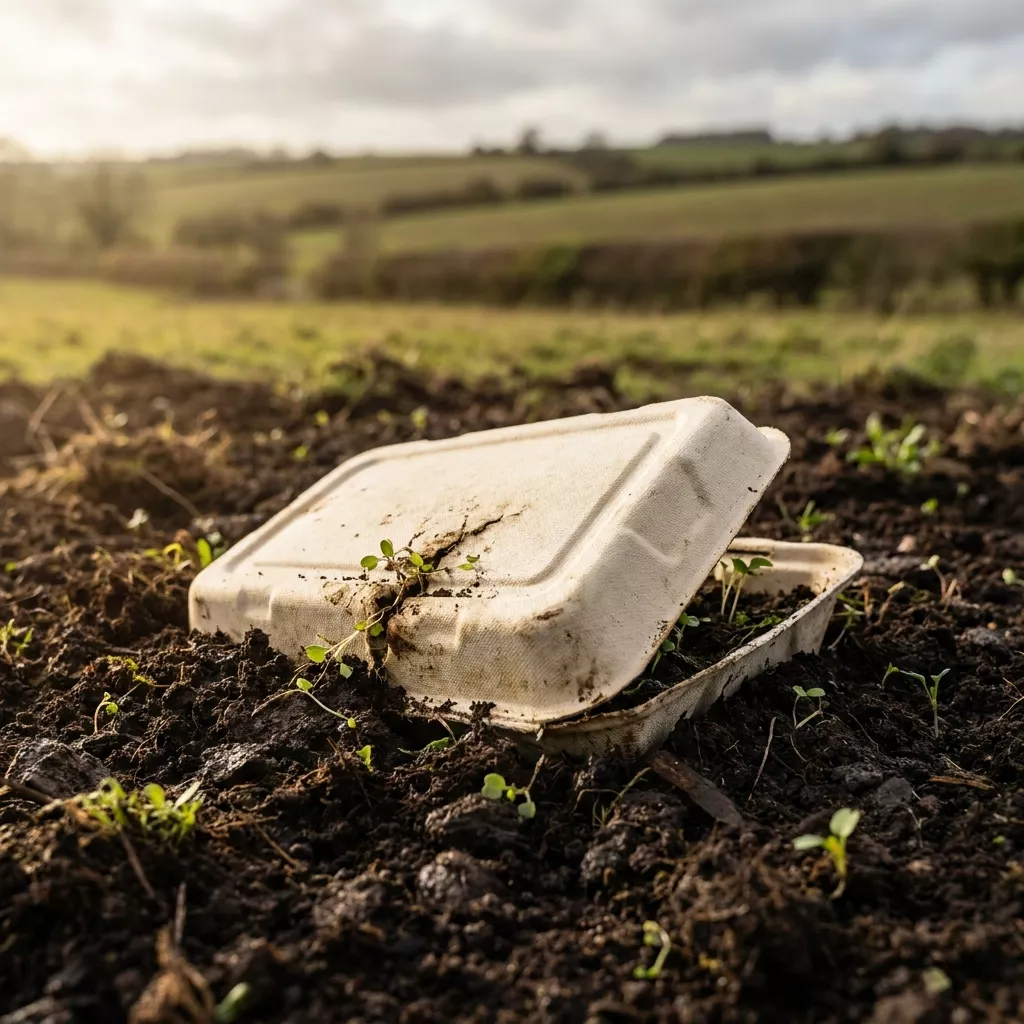
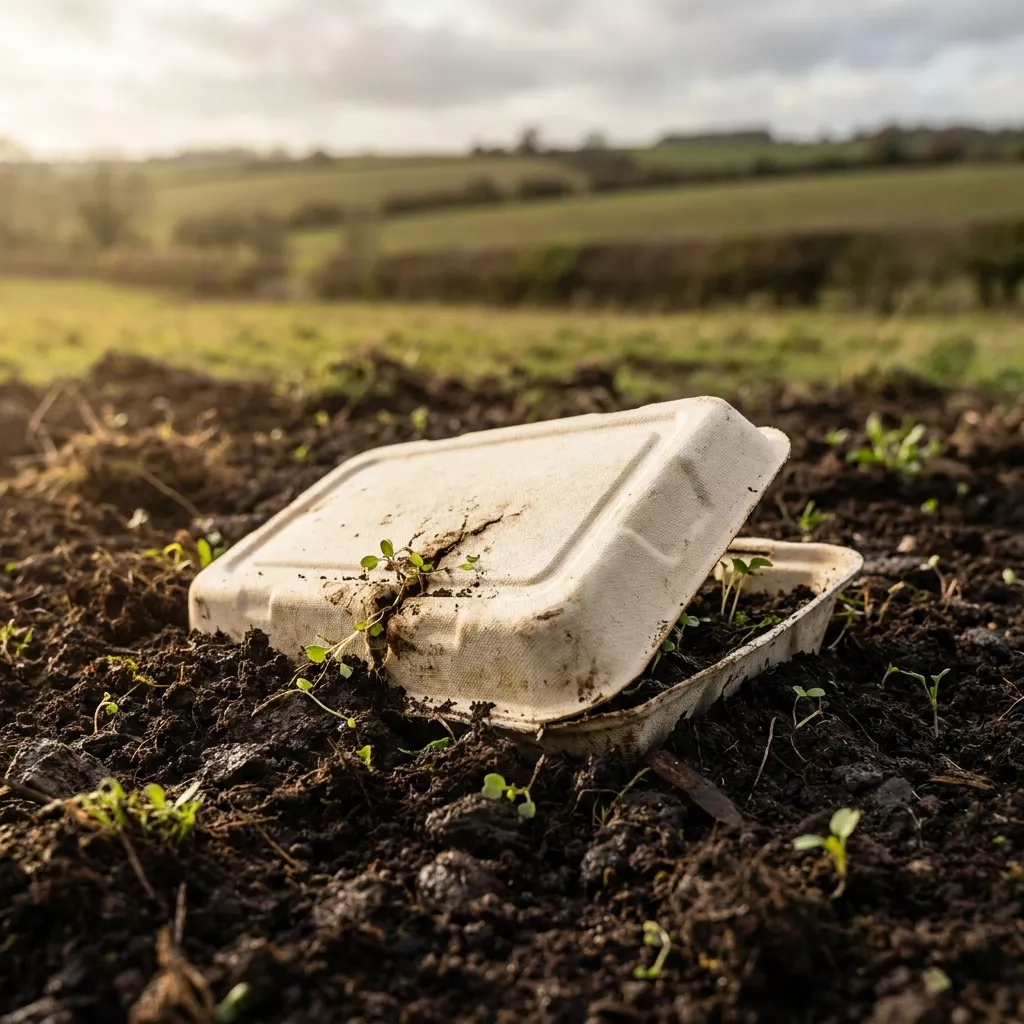
Because every piece of packaging tells a story after it leaves your store. The question is whether that story ends in a landfill — or in a field, feeding the soil that grows tomorrow's food.