Cookie Privacy Preferences
We utilize essential cookies to ensure our website operates effectively and remains secure. Additionally, we'd like to request your permission to use optional cookies. These are intended to enhance your browsing experience by offering personalized content, displaying advertisements that are relevant to you, and helping us to further refine our website.
Choose "Accept all cookies" to agree to the use of both essential and optional cookies. Alternatively, select "Let me see" to customize your preferences.
Privacy Preference Centre
Our website utilizes cookies to enhance your browsing experience and to present you with content tailored to your preferences on this device and browser. Below, you will find detailed information about the function of cookies, enabling you to make informed choices about which cookies you wish to accept. Please note that disabling certain cookies might impact your user experience on our site. It's important to remember that cookie preferences need to be set individually for each device and browser you use. Clearing your browser's cache may also remove your cookie settings. You have the freedom to modify your cookie preferences at any point in the future.
For a comprehensive understanding of our use of cookies, please refer to our complete cookies policy.
These cookies are needed for the website to work and for us to fulfil our contractual obligations. This means they can't be switched off. They enable essential functionality such as security, accessibility and live chat support. They also help us to detect and prevent fraud. You can set your browser to block or alert you about these cookies, but it means some parts of the site won't work.
These cookies allow us to measure and improve the performance of our site. They help us to know how popular pages are, and to see how visitors move around the site. If you don't allow these cookies, we won't know when you've visited our site, and we won't be able to monitor its performance.
These cookies enable us to provide enhanced functionality and personalisation. They may be set by us or by third party providers whose services we've added to our pages. If you don't allow these cookies, some or all of these services may not work properly.
These cookies collect information about your browsing habits to show you personalised adverts. They may be used to build a profile of your interests and show you relevant adverts on other sites. They don't store directly personal information, but are based on uniquely identifying your browser and internet device. If you don't allow these cookies, the adverts you see will be less relevant.
Desktop (hidden)
Responsible packaging for a responsible future
We Make. We Supply. We Deliver

Tablet & Mobile (hidden)

DeliStore - Updated
WELCOME TO AGORA - THE NEW NAME FOR DELISTORE!
Free Shipping For Orders Over £79 ex VAT.
Order By 1pm Monday-Friday For Same Day Despatch.
WELCOME TO AGORA - THE NEW NAME FOR DELISTORE!
Free Shipping On All Orders Over £79 Excluding VAT
Order By 1pm Monday - Friday For Same Day Dispatch
SUSTAINABLE SOLUTIONS
INDUSTRY KNOWLEDGE
FAST SHIPPING
LOW MOQ
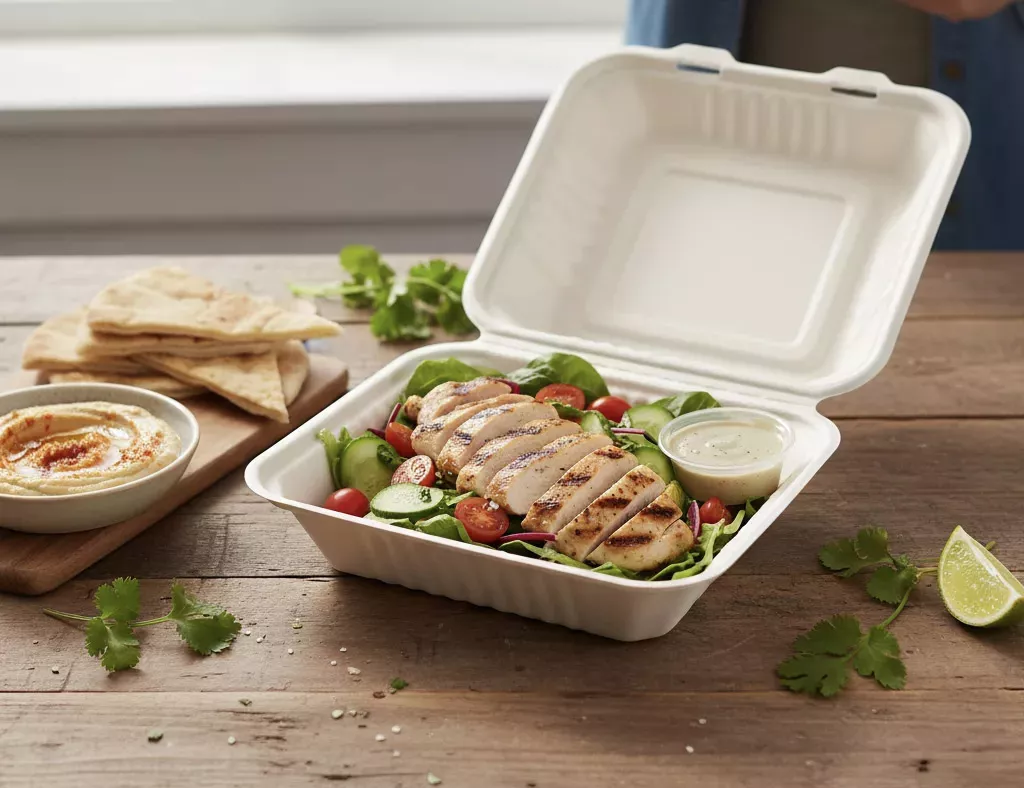
Quick Summary: Food quality degradation during delivery is driven by thermodynamics. To prevent soggy textures and leaks, packaging must manage Moisture Vapour Transmission Rates (MVTR). Using materials like Bagasse and lined Kraft board can scientifically improve heat retention and structural integrity.
In the UK takeaway sector, the "last mile"—the transit time between the kitchen and the customer—is a battle against the laws of physics. For high-starch foods or moisture-rich dishes, the primary enemies are condensation and latent heat.
Understanding the science of packaging allows operators to choose materials that maintain food integrity. Using Agora’s range of professional packaging, we break down how to optimise your delivery quality using material science.
The primary reason fried foods go soggy in transit is condensation. When hot food is placed in a sealed, non-porous container (like traditional plastic), it releases water vapour. As this vapour hits the cooler internal surface of the lid, it undergoes a phase change back into liquid water.
This water then drips back onto the food, re-hydrating the starch molecules—a process known as hydrolysis—which destroys the "crispy" texture. To prevent this, you need a material with a high Moisture Vapour Transmission Rate (MVTR).
Leaking sauces are often the result of the failure of a material's barrier properties. Many standard paper boxes fail because liquid is absorbed into the fibres via capillary action, causing the structure to soften and collapse under hydrostatic pressure.
During high-heat transit, emulsions (like mayo-based sauces) can "break," and dry components (like rice or bread) can suck moisture out of the main dish. This is called osmotic migration.
| Metric | Bagasse (Sugarcane) | Kraft Board (Lined) | PP Plastic |
|---|---|---|---|
| Breathability | High (Prevents sogginess) | Low | Zero (High condensation) |
| Thermal Retention | High (Insulating) | Moderate | Low |
| Grease Barrier | Natural Fibre Barrier | Internal Coating | Total Barrier |
Science-backed kitchens also consider Headspace—the air volume between the food and the lid. Excess headspace allows for increased air circulation, leading to rapid cooling via convection.
Operational Tip: Match the container size to the portion. Using a larger box for a small portion increases the surface area for heat loss. Switching to a size-matched Agora container maintains the internal temperature for a longer duration.
Bagasse is a moulded fibre with superior thermal insulation properties compared to standard single-wall cardboard. It helps keep food above the 63°C food safety threshold for longer while allowing steam to vent naturally.
This is usually caused by vapour pressure build-up. When steam cannot escape, it pushes against the lid. Using breathable materials like Bagasse or vented Kraft containers relieves this pressure, ensuring the lid remains securely seated.
Our products are selected based on high performance and regulatory compliance. For grease resistance, we utilise mechanical moulding techniques (in Bagasse) and high-quality internal barrier linings (in Kraft). For specific technical specifications regarding any of our ranges, please contact our team.